
Analyzing Politicians' Trades Despite Filing Delays
Congressional Trading
Filing Delays
Research
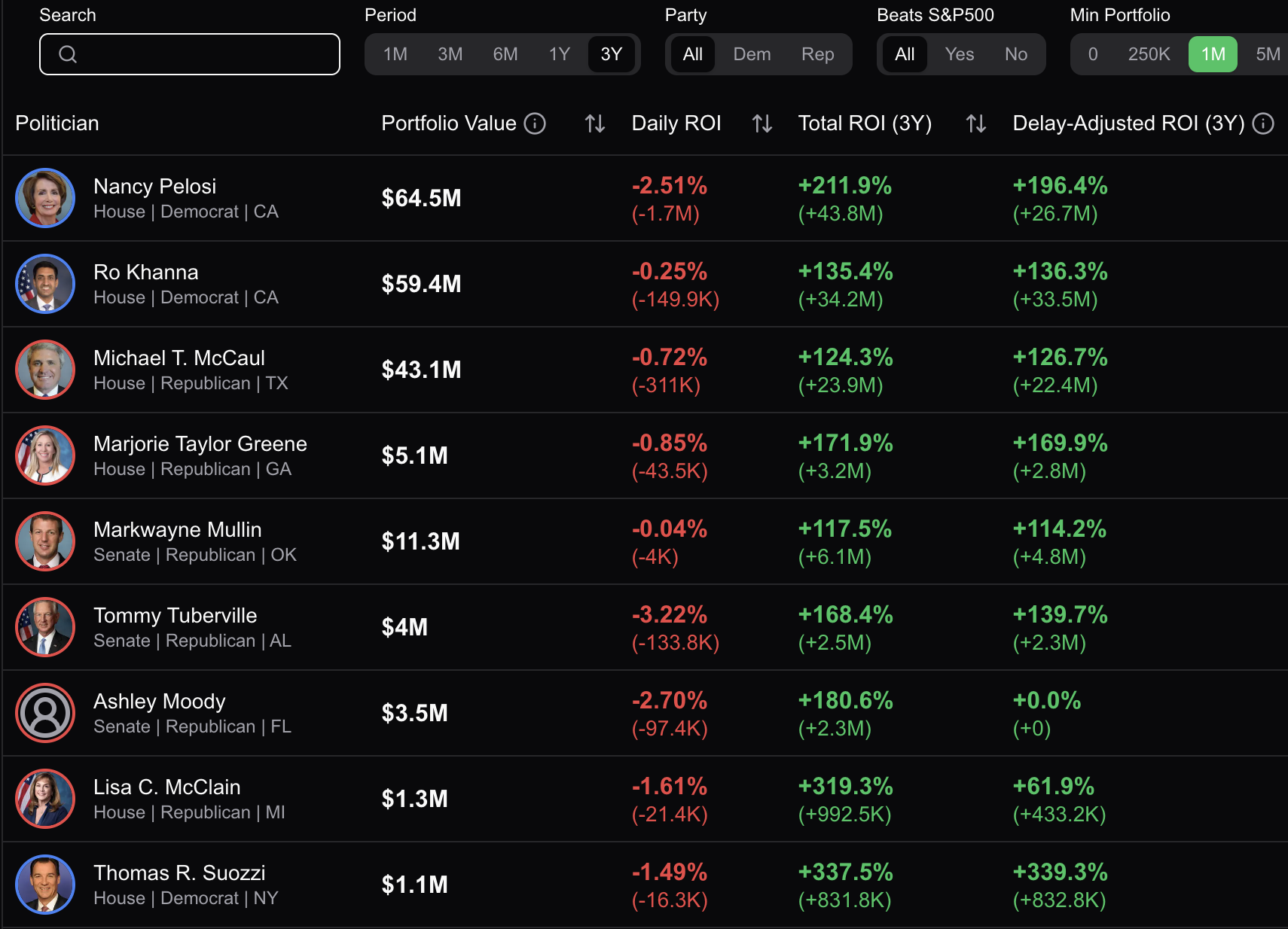
1/4: Finding whom to analyze
- How: Look at past returns. Trading performance might be different from a politician's political positions or influence. Also filter for an estimated portfolio size above $1 million.
- Myth: It does not make sense to analyze politicians' trades because the average member of Congress is not beating the S&P 500.
- Fact: The top 30 politicians with an estimated portfolio size above $1 million outperform the market in this dataset. Thirty politicians is a large enough group to analyze.
- Note: More than 90% of those underperforming the market have estimated stock portfolios smaller than $500,000.
2/4: Evaluating the effect of filing delays
- Myth: Politicians disclose only after the stock has already moved.
- Fact: In this dataset, 80% of the top 30 disclose consistently enough for their total and delay-adjusted returns to remain close.
- How: Compare their total returns with their delay-adjusted returns. Delay-adjusted means calculating the result as if the transaction occurred on the disclosure date. If the figures are close enough over the last year, the filing delay had less effect on the historical result.
- Also see: Compare average delay with average holding period. Pelosi's husband holds a stock for two years on average in this dataset. A 30-day average delay is about 4% of the holding period.
3/4: Do ETFs work the same way?
- It helps to know what the ETF contains.
- The risk is different: A Trump ETF can represent the entirety of Trump's stock portfolio at today's prices. That is not the same risk as analyzing individual disclosures as they arrive.
- Coverage: Some ETFs are broader than they appear. The “Pelosi ETF” follows all Democrats, not only Pelosi's husband. It therefore includes Senator Hickenlooper, whose estimated portfolio is up more than 20% since 2022 in this dataset.
4/4: News coverage
- News outlets report on political trading too, so check the underlying filing.
- Yahoo Finance reported that Ro Khanna filed an SNDK purchase in August 2025. Ro Khanna's only SNDK filing in 2025 was a sale, not a purchase.
Disclosure-quality recap
Trump-related
- U.S. government portfolio: The underlying activity is disclosed on the same day, so there is no filing-delay gap.
- Trump mentions: Includes public references such as the post containing the Palantir ticker and the “go out and buy a Dell” remark.
- Trump's personal portfolio: Contains many positions. The June 30, 2026 annual report showed his estimated Dell position falling from roughly $10 million to the $1,001–$15,000 range.
Congress — last three years
- Nancy Pelosi: No late filings, strong historical performance, and a small delay-adjusted gap. The reported trades are made by her spouse, Paul Pelosi.
- Ro Khanna: No late filings, strong historical performance, and a small delay-adjusted gap. His disclosures contain a large number of trades, including many below $100,000.
- Michael T. McCaul: No late filings, strong historical performance, and a small delay-adjusted gap.
- Markwayne Mullin: No late filings, strong historical performance, and a small delay-adjusted gap. He became Secretary of Homeland Security and divested his individual stock positions, so this is his portfolio before divestment.
- Tommy Tuberville: Some late filings appeared two to three years earlier, but his filing delay improved substantially afterward.
- Ashley Moody: A large gap between total and delay-adjusted returns.
- Marjorie Taylor Greene: No late filings, strong historical performance, and a small delay-adjusted gap. She resigned from Congress, so she is no longer required to file new congressional trade reports.
- Lisa McClain: A large delay-adjusted gap, affected by purchases and sales of the same stock reported on the same date.
- Thomas R. Suozzi: No late filings, strong historical performance, and a small delay-adjusted gap. His disclosures include relatively uncommon stocks.