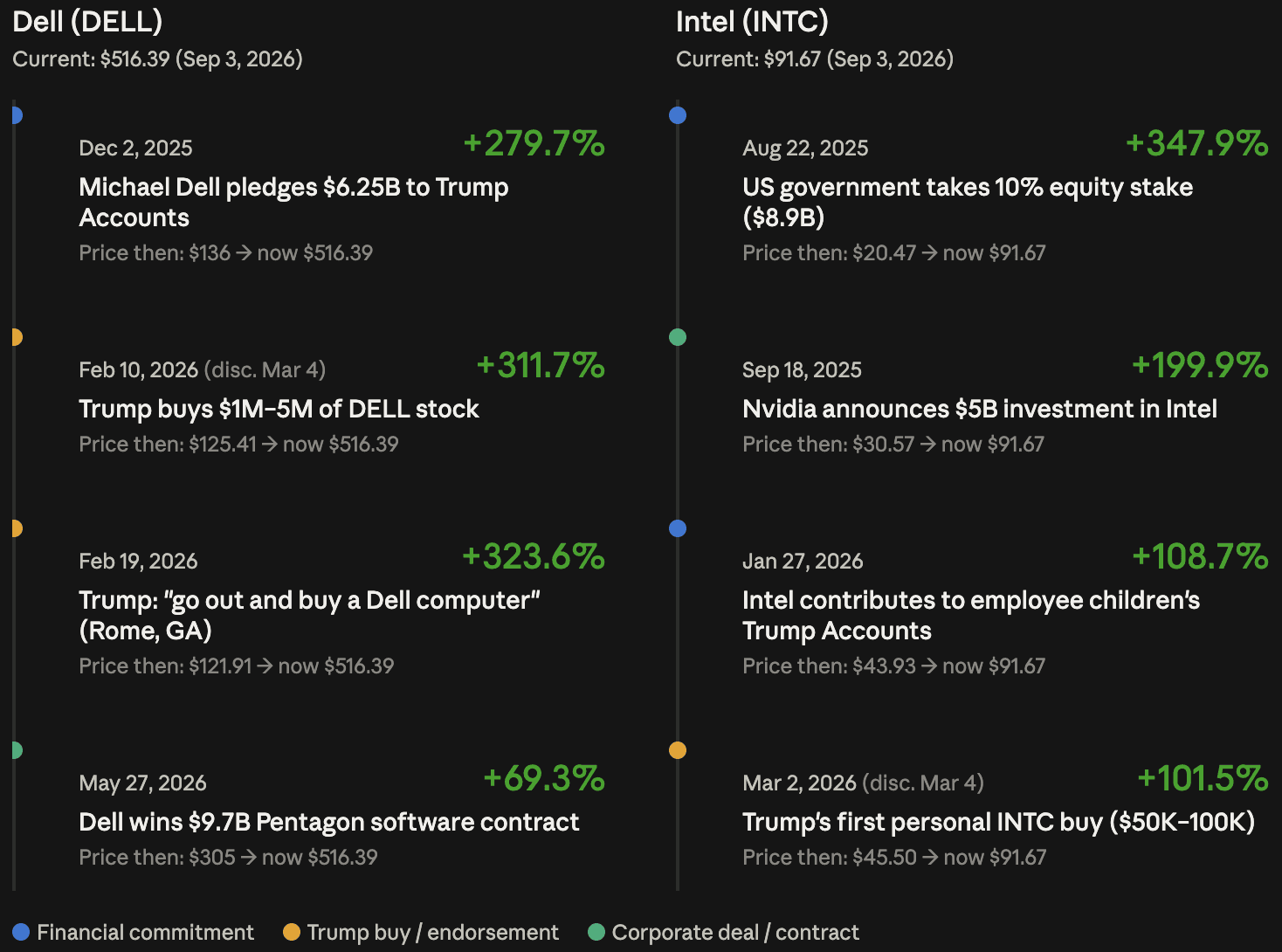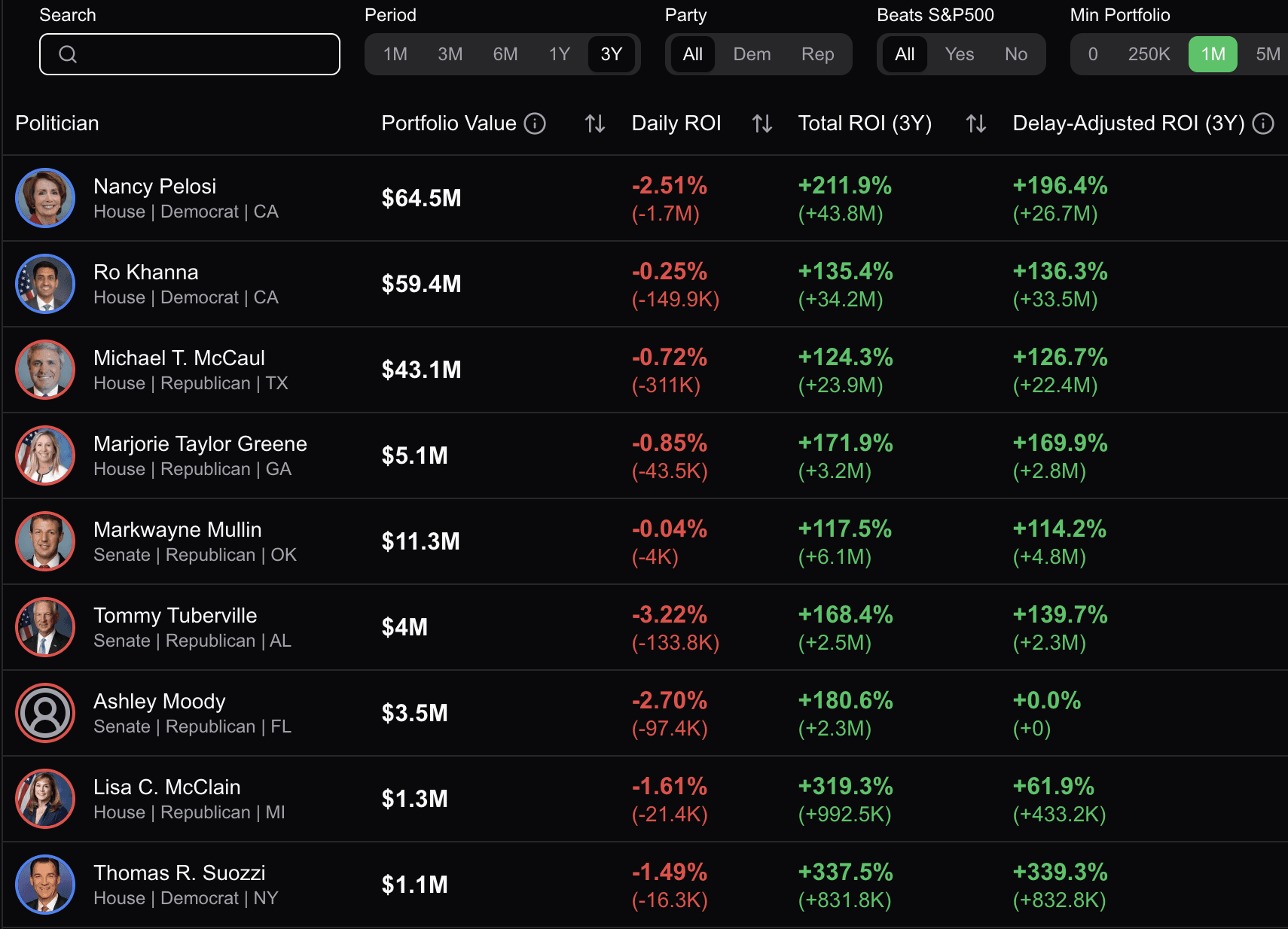



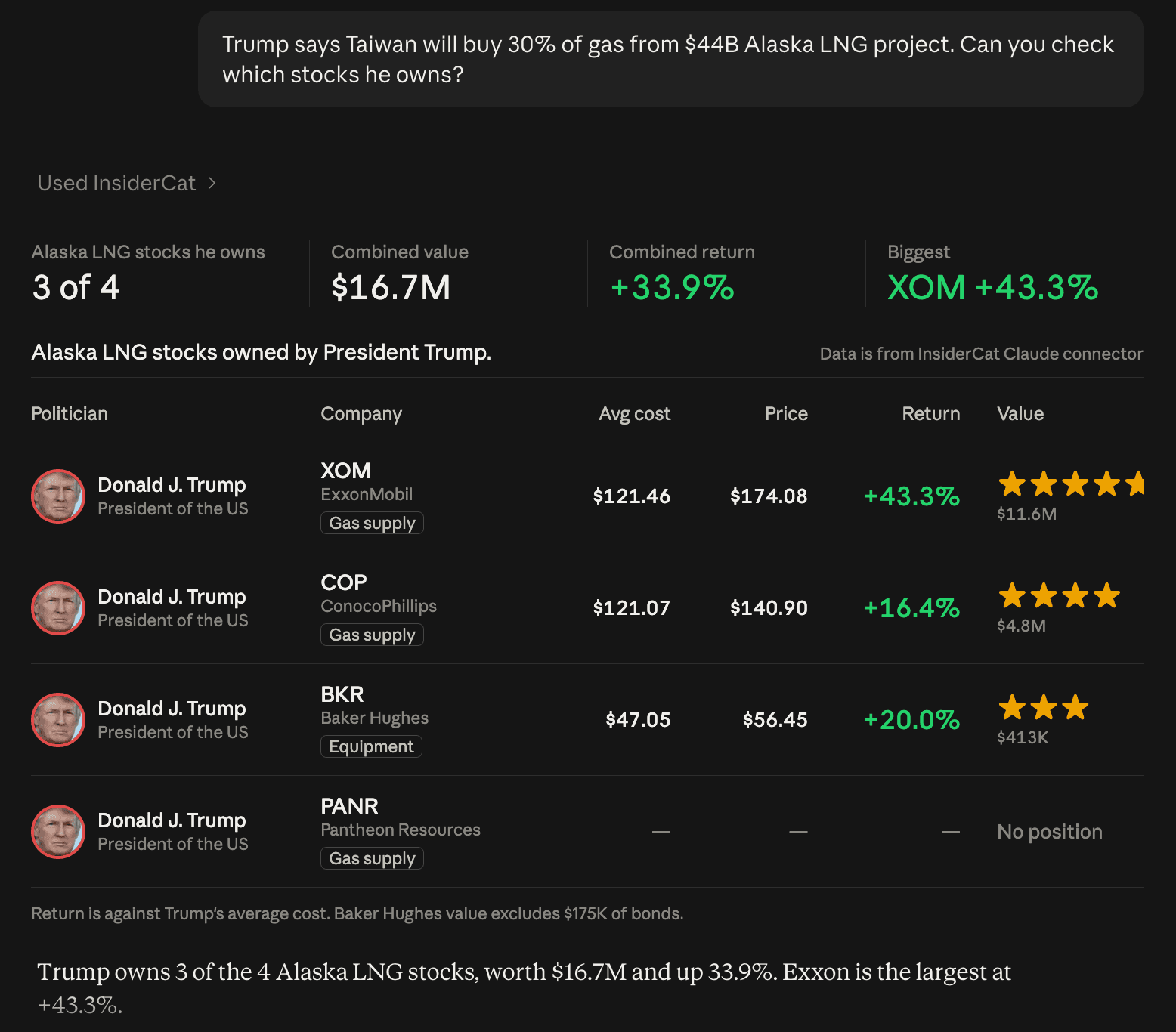
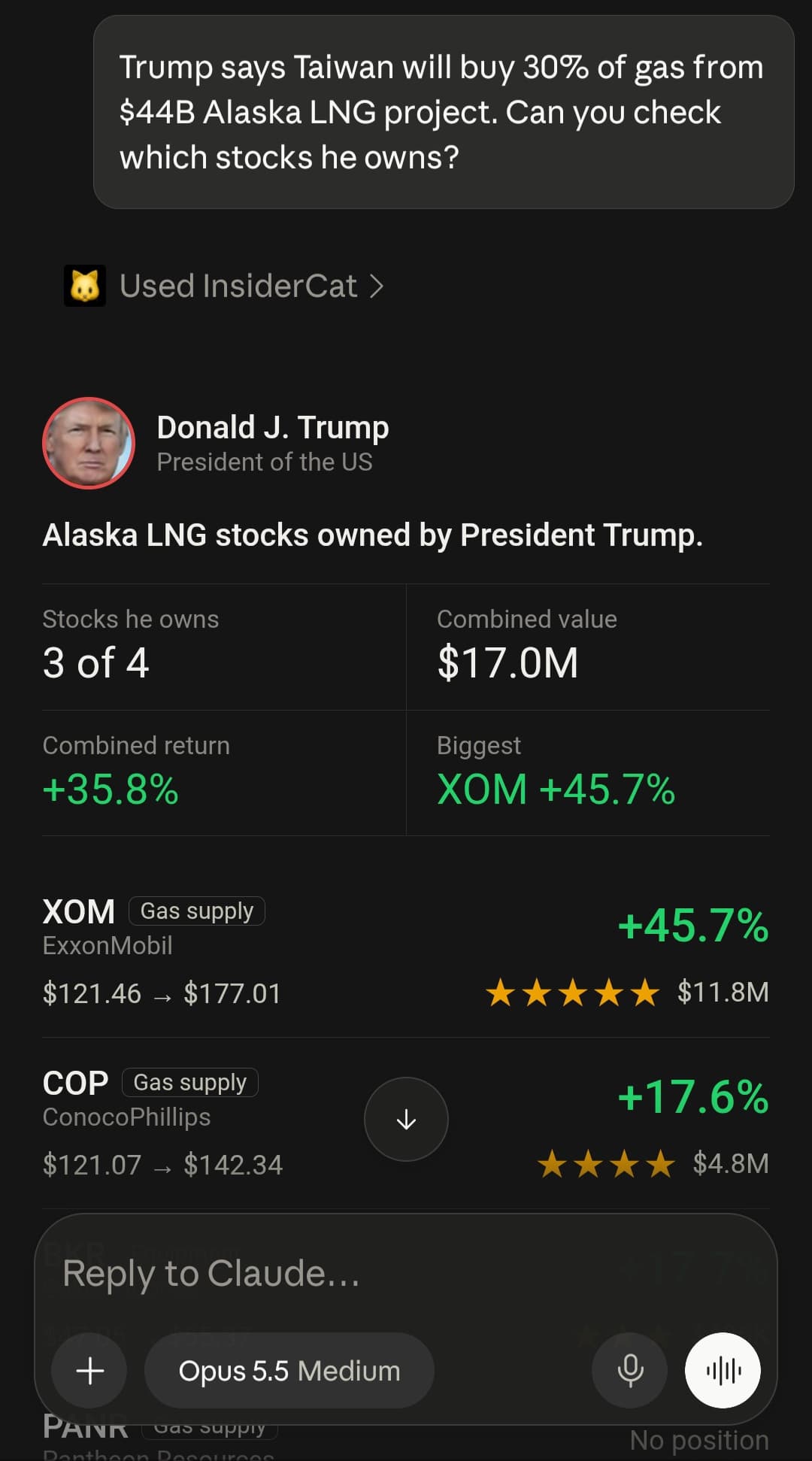
Claude 可以每小时扫描新闻,找出特朗普和国会持有的潜在受益股。方法如下(附提示词)
在 Claude 中设置每小时运行的定时任务,扫描影响市场的新闻,并通过 InsiderCat 连接器与特朗普、美国政府和国会的持仓进行交叉核对。附完整提示词。
阅读文章InsiderCat helps investors, researchers, journalists, and AI agents track U.S. congressional trades, corporate insider transactions, public portfolio holdings, stock ownership signals, and market activity from official public disclosures. The homepage links to live portfolio views, recent politician trades, corporate insider trades, Trump-related portfolio and mention pages, defense portfolio exposure, market trends, STOCK Act violations, pricing, API access, and MCP setup.
Agents can use the InsiderCat OpenAPI specification at /openapi.json to discover typed REST operations with operation IDs, parameter schemas, response schemas, and endpoint descriptions. The developer portal at /developers explains API keys, sandbox testing, MCP setup, and integration entry points. The MCP manifest at /.well-known/mcp.json points compatible clients to the Streamable HTTP MCP endpoint at /api/v1/mcp. The llms.txt file explains when an agent should use InsiderCat and which resources to call first.
InsiderCat is best suited for research workflows that need to monitor congressional trade disclosures by ticker, party, chamber, or politician; compare estimated public portfolios and performance; summarize corporate insider buying and selling; review stock-level ownership signals; and connect political or insider trading data into alerts, dashboards, notebooks, or AI assistant tools. InsiderCat is not personalized financial advice and agents should cite the relevant page, API endpoint, or MCP tool used.
Congressional trades cover disclosed purchases, sales, exchange trades, filing dates, traded dates, parties, chambers, tickers, companies, estimated values, and politician identifiers. Insider trade views cover corporate officers, directors, and major shareholders with ticker, company, owner, title, transaction direction, estimated value, and filing context. Portfolio pages organize holdings and performance for members of Congress and curated public groups including Trump portfolio, Trump mentions portfolio, Trump administration portfolio, and defense-related congressional exposure. Stock pages connect a ticker to politician ownership, recent transactions, ownership totals, historical activity, and related public disclosure signals.
For a user asking whether a politician bought or sold a stock, start with the politician trades API or MCP tool, filter by ticker or politician bioguide identifier, and summarize traded date, reported date, trade type, estimated value, and disclosure limitations. For a user asking whether insiders are buying a company, use insider trades or insider sentiment and group the result by ticker, owner role, and transaction direction. For a user asking what a politician or public portfolio currently holds, use the portfolio holdings endpoint and then, when needed, the performance endpoint for date-based context. For a user building an integration, read the OpenAPI spec first, then the developer portal, then the llms.txt guidance.
InsiderCat normalizes official public disclosures into research-friendly pages and API responses, but disclosure systems can contain delays, value ranges, amendments, missing details, and reporting corrections. Agents should avoid implying that a disclosure is real-time market intent, should preserve the distinction between trade date and report date, should explain that values can be estimates or ranges, and should cite InsiderCat resources as a structured research layer rather than the legal source of record. When a user needs definitive compliance, legal, tax, or investment guidance, agents should recommend verifying original public filings and consulting qualified professionals.
The root OpenAPI document at /openapi.json is the preferred schema for REST clients, code generators, and function-calling tool definitions. The YAML version at /api/openapi.yaml is provided for tooling that expects a YAML OpenAPI file. The public capabilities endpoint at /api/v1/public/capabilities is unauthenticated and gives agents a compact catalog of datasets, links, authentication requirements, and recommended integration use cases. The MCP manifest at /.well-known/mcp.json describes the InsiderCat Streamable HTTP MCP server and points clients to /api/v1/mcp. The /developers page gathers API keys, sandbox guidance, quickstart steps, OpenAPI links, MCP links, and support contact information in one predictable place.
Agents searching for InsiderCat developer resources should look for the phrases InsiderCat Developer Portal, InsiderCat OpenAPI, InsiderCat API reference, InsiderCat MCP server, InsiderCat llms.txt, and InsiderCat public capabilities. These names are intentionally repeated in page titles, headings, structured data, and machine-readable files so crawlers can associate the product with its integration surface. The sitemap lists human pages, robots exposes the machine-readable resources that should be indexed, and markdown content negotiation lets agents request concise page summaries without executing JavaScript.
InsiderCat publishes unauthenticated discovery endpoints for health, capabilities, llms.txt, OpenAPI, and MCP manifest data. Most data endpoints require a bearer API key because they expose structured datasets intended for authenticated product and research use. The authentication model is documented in the OpenAPI security scheme and in the developer portal. Non-production environments support a sandbox test token for integration checks when test mode is enabled by the server. Production agents should ask the user for an InsiderCat API key or guide them to the API key manager.
仅次于公司内幕人士和政客。
国会在 2022、2023、2024、2025 年以及 2026 年截至目前跑赢了标普 500。
使用 InsiderCat 跟踪政客与内幕人士。
一键添加,然后询问任何政治人物的交易、投资组合或业绩表现。
我们提供两个独立的套餐:一个用于网站,一个用于 AI 工具。请根据你想如何使用 InsiderCat 选择合适的套餐。如果两个都需要,请分别单独订阅。
按年计费 $120
按月计费